Table Saw Vs Band Saw
In regard to precision cutting in woodworking, the band saw vs table saw debate is one that woodshop owners and DIYers can’t brush aside. Each saw carries out a different purpose but knowing which one to use (and when) can seriously increase your workflow, safety, and the outcome.
Let’s cut straight to it.
What’s are the Differences Between a Table Saw and a Band Saw?
The following are the differences between a table saw and a band saw
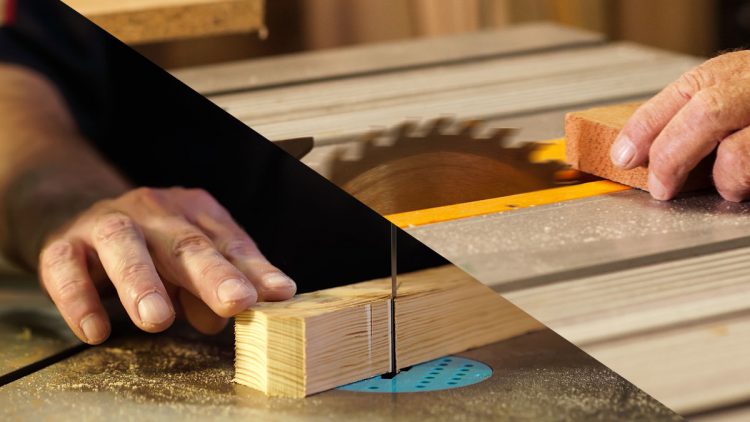
Table Saw
- Utilizes a round blade that comes up through a table surface
- Perfect for straight, precise rip cuts and crosscuts
- Ideal for sheet goods, cabinetry, and recurrent cuts
Band Saw
- Utilizes a long, continual blade looped over wheels
- Perfect for curves, resawing, and unconventional shapes
- Ideal for custom moldings, rounded trim, and joinery work
Both are shop essentials, but they carry out very different roles in interior woodworking.
How Does a Band Saw Cut in Comparison to a Table Saw?
Table saws cut by rotating a round blade upwards through the wood. They’re ideal for dimensioning stock and guaranteeing square, clean edges.
Band saws cut with a slim vertical blade that moves in a loop. This enables for angled cuts, tight curves, and vertical re-saws.
Therefore, if you’re going to cut a 3/4″ plywood down to cabinet-like width, utilize a table saw. However, if you’re shaping an arch for a doorway casing, go for a band saw.
What Projects Are Best for a Band Saw as Opposed to a Table Saw?
Project Type-Best Saw
- Curve cutting (for instance, arches)- Band Saw
- Resawing of thick boards- Band Saw
Project Type-Best Saw
- Layer goods & cabinetry- Table Saw
- Straight rip-cuts on hardwoods- Table Saw
- Long miter or bevel cuts- Table Saw
In interior architectural woodworking, trim shops often depend on both—but each one plays an individual role.
Pros & Cons: Table Saw Vs Band Saw
The following are the pros and cons of table saws vs band saws
Table Saw
Pros
- Precision on straight cuts
- Variable fence and miter gauge
- Perfect for high-volume production
Cons
- Not as safe (kickback risk)
- Restricted to straight lines
- Can’t address irregular shapes
Band Saw
Pros
- Cuts curves easily
- Safer operation (slight kickback)
- Perfect for resawing and detail work
Cons
- Not ideal for long, straight rip-cuts
- Requires more skill to guide manually
- Blade movement could impact precision
Is a Band Saw Safer Than a Table Saw?
Yes—band saws are typically deemed safer than a table saw.
- Band saw blades move downward, decreasing kickback
- Smaller exposed cutting area
- Less probable to cause serious injury in improper use
Nevertheless, each tool demands attention and proper PPE. Utilize push block, edge covers, and always adhere to safety protocols—without regard to the saw.
What Are the Constraints of a Band Saw and a Table Saw?
The following are the constraints of a band saw vs a table saw
Band Saw Constraints
- Not ideal for layered goods
- Cuts are slower and less refined on long stock
- Precision requires jigs or steady hand
Table Saw Constraints
- Unable to cut tight curves
- More dangerous for novices
- Constrained by fence and table size for odd-shaped pieces
Basically, don’t try to force one saw to do it all. Each saw has advantages, and using the incorrect one can result in poor cuts or safety concerns.
Should You Use a Band Saw Instead of a Table Saw?
Only if the job calls for it.
Use a band saw when:
- You’re cutting shapes or curves
- You are required to re-saw thicker stock
- You wish for cleaner cuts on intricate material
Use a table saw when:
- You’re rip-cutting layer goods
- You need consistent, accurate cuts
- Speed and efficiency are a priority
The Outcome: Band Saw vs Table Saw for Woodworking Professionals
If you’re doing interior architectural woodwork, there’s a good chance you need both.
- A table saw is your go-to for clean, duplicate straight cuts
- A band saw is your sculpting device, ideal for curves, resaws, and intricate work
Woodworking Supplies Mesa by Timber Woodworking
Timber Woodworking offers hardwoods in Mesa, Arizona. We specialize in woodworking tools, equipment, and supplies for commercial woodworking cabinet shops or furniture manufacturers as well as the home shop hobbyist. Contact us today, or call if you should have any questions.