
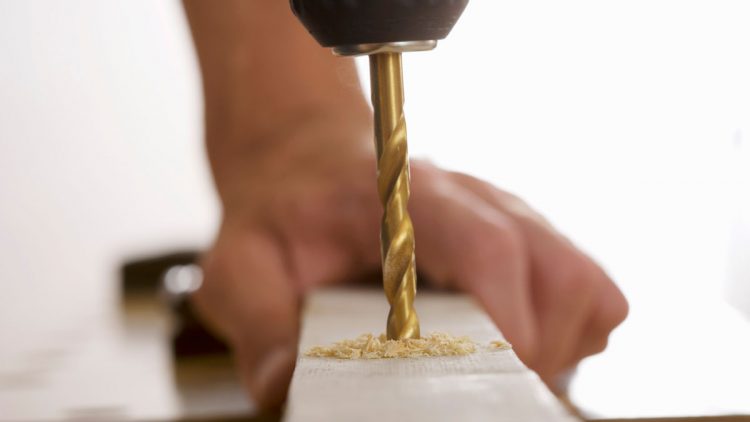
Types of Drills
Before drills had electric motors for use in the home in the 40’s, handymen used hand cranked types. A lot of sweat and tears! Drills are a vital tool for a lot of various types of work, from construction to woodwork, to simple DIY projects.
Drills can additionally be broken down if they are a cordless drill (which provides mobility and convenience) or corded (which provides more constant power; however, requires cables that could get tripped on or an extension cord (still a tripping hazard) if you are away from a power source).
Different Types of Drills and Their Features
The following is a look at five different types of drills.
1. Standard Drill
We know that drills are probably one of the most multipurpose tools in any handyperson’s tool arsenal. They can be utilized for everything from creating holes in walls to driving screws into cabinetry.
The most basic type is the standard drill which comprises of a motor that rotates a drill bit (clockwise or counterclockwise), which is held in place by what is known as a chuck.
The rotation of the drill can be changed by switching the position of a chuck, and most drills additionally have a reverse operation that can be used to remove screws or drill out unwanted knots in wood.
2. Hammer Drill
Hammer drills are used for drilling into masonry (brick, stone, etc.). It works by using a rotating drill bit for creating a hole, while simultaneously delivering fast, powerful blows to the material from the drill bit itself.
This combination of drilling and hammering operation is what makes hammer drills so effective at creating holes in even the toughest materials. The power and speed can be adjusted to better suit the material that is getting drilled, and different drill bits can be used for different applications.
3. Impact Drill
An impact drill provides high power and torque and utilizes a similar hammering operation for creating holes in concrete or other hardened materials. The hammering operation makes it possible to drill through harder materials; however, it additionally makes the drill more challenging to control. Using an impact drill the power is delivered vertically to the bit, instead of from the bit itself.
Consequently, corded impact drills are usually used by experienced professionals for larger projects. On the other hand, cordless impact drills get their power from a charger, or batteries, making them more mobile and a perfect choice for small-scale projects around the house.
4. Core Drill
A core drill is used for creating a hole in the center of an object. The most typical type of core drill is the diamond core drill, which utilizes a diamond-tipped drill bit to drill through hard materials. These types of drills are often used for creating holes for electrical wiring or plumbing or for removing samples of material for testing (core sampling). They can also be used for creating aesthetic patterns in concrete or stone. Generally, core drills are very versatile devices that can be used for a multitude of purposes.
5. Drill Press
A drill press is a worktable device that drills holes and is for the individual that requires more accuracy as they drill. It comprises of a base, a pillar or column and a head in addition to a table attached to the pillar/ column. The drill chuck is attached to the spindle, and the bit gets inserted into the chuck. The speed, depth, and alignment of the hole you are drilling can then all be managed using the drill press.
Common Mistakes Beginners Make When Using a Drill
Drills are a multipurpose tool that can be used for a variety of tasks, from helping to hang pictures to assembling furniture. Nevertheless, drills can also be hazardous if you are a little reckless using them, so it’s vital to use them properly. The following are four common mistakes novices make when using a drill:
- Failing to wear eye protection
Drilling creates a lot of dust and debris, which could easily get into your eyes. Always wear safety goggles or glasses when using a drill or similar tools.
- Not using the correct drill bit
There are various types of drill bits for drilling various materials. Using the incorrect bit can damage the material you are drilling into, causing the drill to slip.
- Holding the drill too tight
If you’re holding the drill too tight, you might lose control of it, causing an injury. Alternatively, hold the drill lightly but securely using both hands. It’s a perfect exercise in not being so tense.
- Neglecting Pilot Holes
Failing to drill a smaller “pilot” hole prior to inserting a screw, or dowel, can cause wood to split or make it challenging to keep the screw, or dowel straight.
Woodworking Supplies Mesa by Timber Woodworking
Timber Woodworking offers hardwoods in Mesa, Arizona. We specialize in woodworking tools, equipment, and supplies for commercial woodworking cabinet shops or furniture manufacturers as well as the home shop hobbyist. Contact us today, or call if you should have any questions.